If you want more customers to find your business through Google, there are two obvious routes.
SEO.
And PPC.
Both can put your business in front of people who are actively searching for what you offer.
But they work in very different ways.
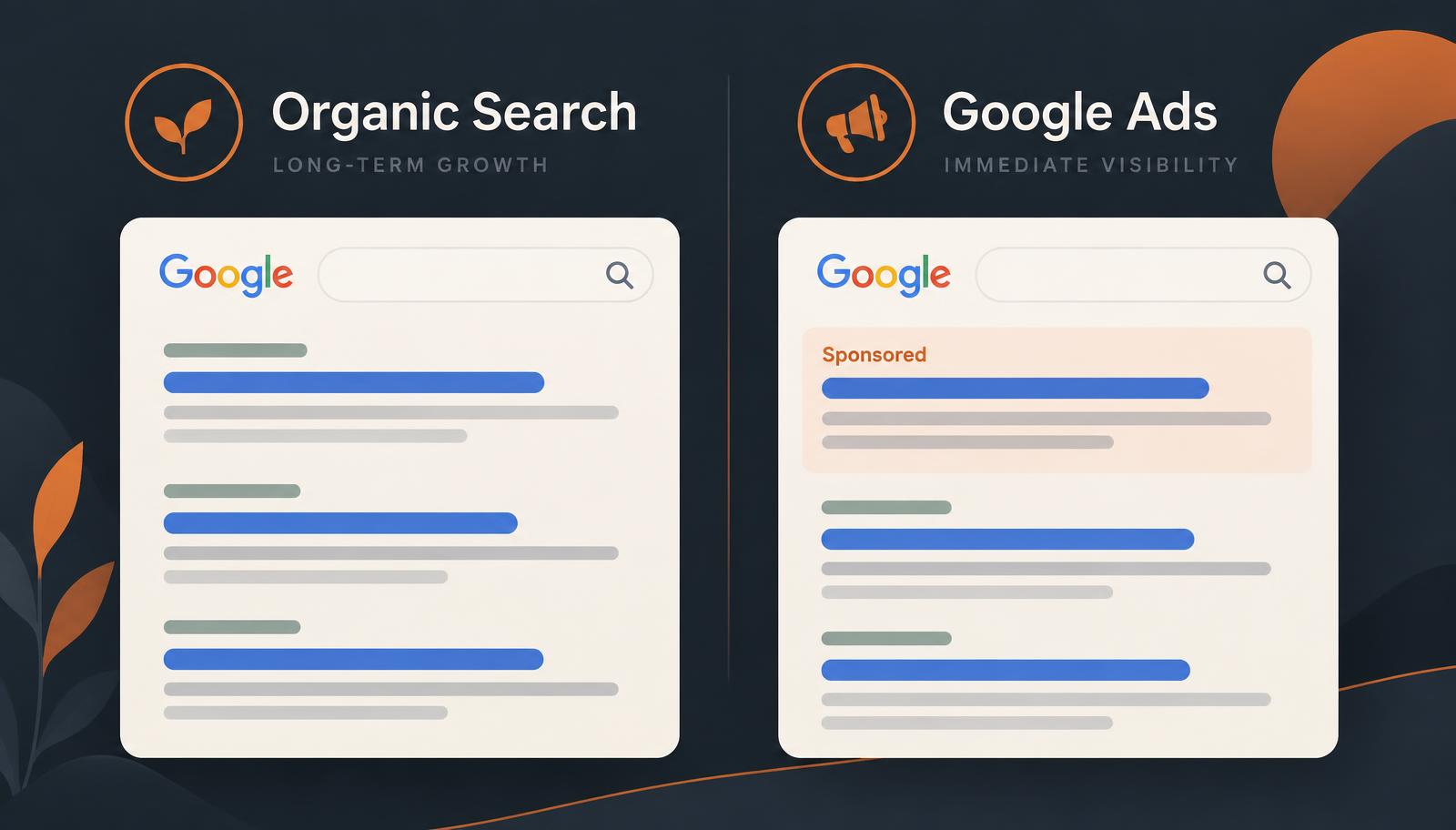
SEO is focused on improving your organic visibility in search results.
PPC allows you to pay for advertising positions, typically through platforms such as Google Ads.
The question is not really whether SEO is better than PPC.
The better question is:
Which one is more appropriate for what your business is trying to achieve?
What is SEO?
SEO stands for Search Engine Optimisation.
It is the process of improving a website so search engines can better understand:
- what the business does
- what each page is about
- where the business operates
- which searches the website may be relevant for
SEO can involve many different areas.
These may include:
- keyword research
- service page optimisation
- page titles
- headings
- metadata
- internal linking
- website structure
- technical SEO
- local SEO
- content
- Google Search Console
- crawlability
- indexation
SEO is generally considered a longer-term strategy.
You are trying to build organic visibility that can continue generating traffic without paying for every click.
What is PPC?
PPC stands for Pay Per Click.
In simple terms, you pay when someone clicks on your advertisement.
Google Ads is the platform most businesses will be familiar with.
A typical paid search campaign might target searches such as:
"web designer Manchester"
"accountant near me"
"roof repair Altrincham"
"family solicitor London"
The advertiser can choose which searches to target, where the ads appear and how much budget is available.
PPC can provide visibility much faster than SEO.
But that visibility usually continues only while the advertising budget is active.
SEO vs PPC: the main difference
The biggest difference is simple.
SEO focuses on earning organic visibility.
PPC focuses on buying paid visibility.
| SEO | PPC | |
|---|---|---|
| Traffic | Organic | Paid |
| Speed | Usually builds over time | Can generate visibility quickly |
| Cost per click | No direct charge for each organic click | Advertiser pays for clicks |
| Control | Less direct control over exact ranking position | Greater control over keywords, locations and budget |
| Longevity | Can continue after initial optimisation | Traffic usually reduces when advertising stops |
| Best for | Long-term visibility and search growth | Immediate commercial visibility |
What are the advantages of SEO?
One of the main advantages of SEO is that good organic visibility can keep delivering traffic over time.
You are not paying Google every time someone visits an organic result.
That makes SEO particularly attractive for businesses that want to build longer-term search visibility.
SEO can also help strengthen the website itself.
Good SEO often involves improving:
- page structure
- service pages
- content quality
- internal linking
- website clarity
Those improvements can help users as well as search engines.
What are the disadvantages of SEO?
SEO is rarely immediate.
A new website may take time to:
- be discovered
- be indexed
- build authority
- gain rankings
- establish local relevance
Competition also matters.
Ranking for a niche service in a small town may be very different from competing for a major commercial search across London or Manchester.
SEO should therefore be viewed as an investment rather than an instant lead-generation switch.
What are the advantages of PPC?
PPC can put a business in front of potential customers very quickly.
That can be particularly useful when:
- launching a new website
- introducing a new service
- targeting a specific location
- entering a competitive market
- testing demand
- generating traffic while SEO develops
Paid search also provides significant control.
You can choose:
- target locations
- keywords
- budgets
- schedules
- landing pages
- ad copy
And with appropriate tracking, you can begin to understand which searches actually generate enquiries.
What are the disadvantages of PPC?
The obvious disadvantage is cost.
You pay for traffic.
And some industries can have expensive clicks.
That means campaign quality matters.
Poorly configured campaigns can waste money on:
- irrelevant searches
- broad targeting
- poor locations
- weak keywords
- unsuitable landing pages
This is why PPC management is not just about creating an advert and switching it on.
Campaign structure, negative keywords, search terms and conversion tracking all matter.
Is SEO cheaper than PPC?
Not necessarily.
SEO may not charge by the click, but good SEO still requires work.
That work may include:
- content creation
- website improvements
- technical optimisation
- local SEO
- ongoing analysis
- link acquisition
- landing page development
The real comparison should not simply be:
"Which is cheaper?"
It should be:
"Which produces the better commercial return for the business?"
Should a small business use SEO or PPC?
For many small businesses, both can have a role.
SEO can help build long-term visibility.
PPC can provide faster access to commercially important searches.
For example, a new local business may initially have little organic visibility.
Google Ads can help generate early exposure while the website begins developing organic rankings.
Over time, SEO may reduce the business's reliance on paid traffic.
That does not mean PPC necessarily becomes unnecessary.
It may still be useful for:
- competitive services
- seasonal campaigns
- new locations
- priority keywords
When SEO may be the better choice
SEO may make more sense where:
- you are building for the long term
- customers regularly search for your services
- you want to build organic visibility
- you have useful expertise and content
- you operate across several services or locations
It can be especially valuable for businesses with strong service pages and clear local targeting.
When PPC may be the better choice
PPC may make more sense where:
- you need visibility quickly
- you are launching something new
- you want to test demand
- you are targeting specific commercial searches
- you want direct control over budget
- you already have a strong landing page
Can SEO and PPC work together?
Yes.
And for many businesses, this can be the strongest approach.
PPC can provide immediate search visibility.
SEO can build longer-term organic visibility.
Together, they can also provide useful information.
For example, paid search can show which keywords produce actual enquiries.
That information can help shape:
- SEO priorities
- landing pages
- service pages
- future content
This is where the two channels become much more powerful when considered together.
Your website still matters
Neither SEO nor PPC can compensate indefinitely for a poor website.
You can rank highly.
You can buy traffic.
But if visitors arrive and see:
- unclear messaging
- weak design
- no trust signals
- poor mobile usability
- confusing navigation
- difficult forms
they may still leave.
Traffic is only one part of the journey.
The website then needs to turn that attention into action.
What should you measure?
Do not judge success only by:
- impressions
- clicks
- rankings
Those metrics are useful, but they are not the final objective.
For most service businesses, more important questions include:
- How many enquiries were generated?
- Which searches generated them?
- What did each enquiry cost?
- Which landing pages performed best?
- Which services produced the strongest demand?
That is why analytics and conversion tracking matter.
What does We Forge Growth focus on?
At We Forge Growth, the aim is not simply to increase traffic.
We look at the wider journey:
Search → Website → Enquiry → Customer
That means SEO, paid search, landing pages and tracking should support each other.
Which should you choose?
If you need visibility quickly, PPC may be the obvious starting point.
If you are building for long-term visibility, SEO may deserve more attention.
If you want both immediate traffic and long-term growth, a combined approach may make sense.
But there is no rule saying every business needs both.
The right strategy depends on:
- your market
- your competition
- your budget
- your website
- your locations
- your commercial objectives
Final thoughts
SEO and PPC are not competing ideas.
They are two different ways of getting your business in front of people who are already searching.
SEO can build valuable organic visibility over time.
PPC can create immediate exposure and provide more direct control.
The strongest approach is usually the one that fits the business rather than blindly choosing one channel over the other.
Frequently Asked Questions
Is SEO better than PPC?
Neither is automatically better. SEO is generally better suited to building long-term organic visibility, while PPC can provide faster paid visibility.
How long does SEO take to work?
There is no fixed timescale. Results depend on competition, the current website, search demand, technical condition and the strength of competing websites.
How quickly can PPC work?
Google Ads can begin generating visibility quickly once a campaign is active, although campaign performance usually needs ongoing optimisation.
Do I need PPC if my SEO is already strong?
Not necessarily. However, PPC may still be useful for highly competitive searches, new services, new locations or additional visibility.
Does SEO mean free traffic?
Organic clicks are not charged individually, but effective SEO still requires time, expertise and ongoing work.
Can SEO and Google Ads be used together?
Yes. In many cases they complement one another, providing both immediate paid visibility and longer-term organic growth.