Most business websites don't suddenly stop working.
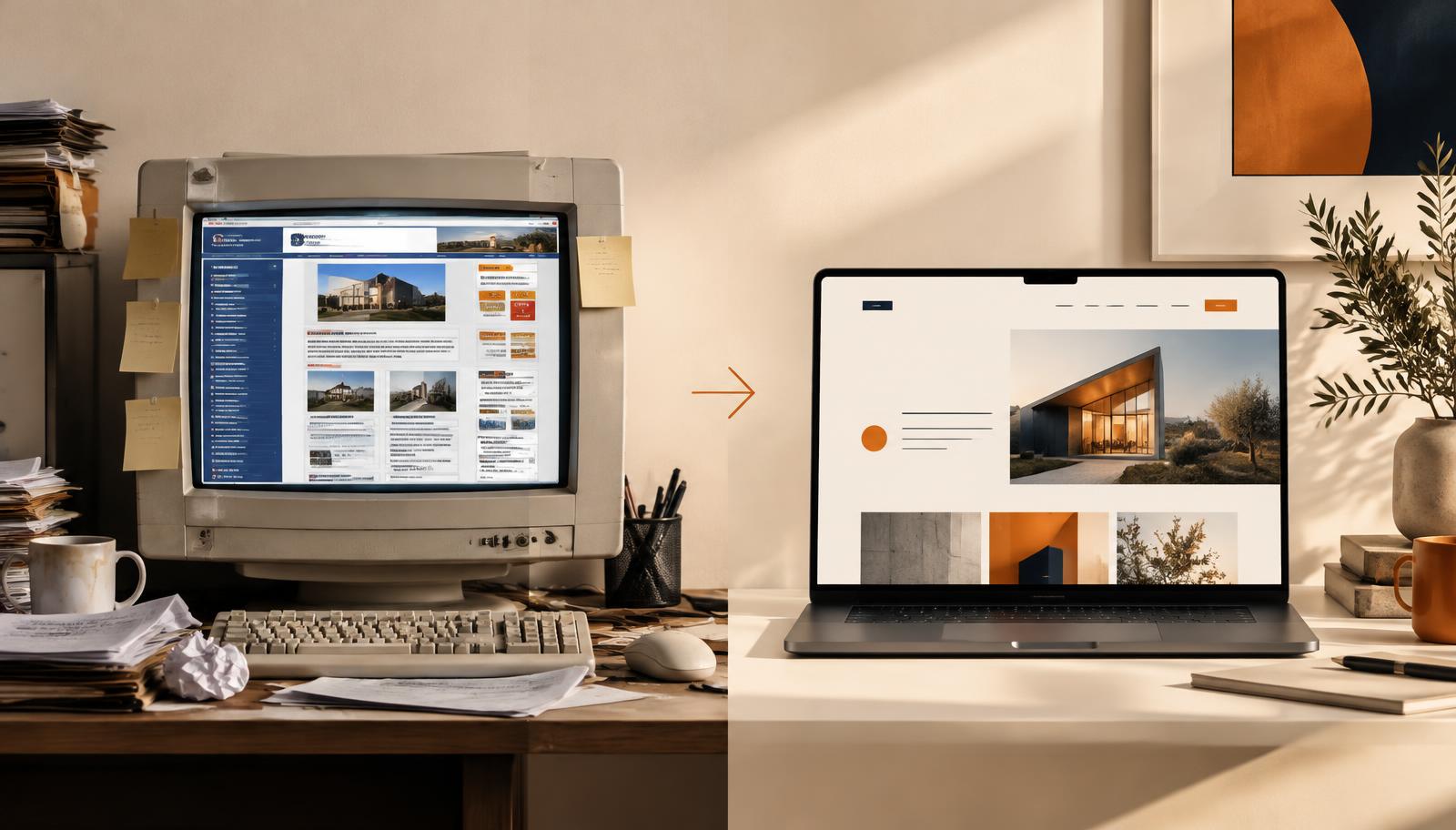
They become outdated gradually.
A new service gets added.
Another page gets bolted on.
The business changes direction.
The branding changes.
The website survives through several rounds of updates until eventually nobody can remember why it was structured that way in the first place.
At some point the question becomes:
Should we keep fixing it or should we start again?
Here are seven signs that rebuilding may be the better option.
1. Your website looks dated
Customers make judgements very quickly.
If your website looks significantly older or less professional than your competitors', that impression can transfer to the business itself.
This doesn't mean following every design trend.
A professional website should age reasonably well.
But obvious signs of age can include:
- cluttered layouts
- tiny text
- dated imagery
- awkward spacing
- inconsistent colours
- old-fashioned navigation
- poor mobile presentation
If your business has moved forward but the website hasn't, the gap becomes increasingly obvious.
2. It doesn't work properly on mobile
For many businesses, mobile is now one of the most important ways customers experience their website.
If users need to:
- pinch and zoom
- fight with tiny buttons
- scroll sideways
- hunt for contact information
the experience is already failing.
A modern website should be designed responsively rather than simply squeezed into a smaller screen.
3. The website is slow
Speed affects both user experience and perception.
If visitors repeatedly wait for heavy pages, oversized images or unnecessary scripts to load, some will simply leave.
Speed problems can sometimes be fixed.
But on older platforms, performance issues may be part of a much larger technical problem.
In those cases a rebuild can be more sensible than repeatedly patching the existing site.
4. You're getting visitors but very few enquiries
Traffic is not the end goal for most business websites.
The website needs to help turn appropriate visitors into customers.
If people are visiting but rarely contacting you, consider:
- Is your service immediately clear?
- Are your calls to action obvious?
- Do you show enough proof?
- Is it easy to contact you?
- Are your pages answering customer questions?
- Does the website feel trustworthy?
A redesign can be an opportunity to rethink the entire customer journey rather than simply changing the colours.
5. Updating the website is difficult
A business website shouldn't become something everyone is afraid to touch.
If changing:
- a telephone number
- a service
- a team member
- an image
- a price
requires a major technical exercise, the underlying system may no longer be serving the business properly.
That doesn't automatically mean rebuilding.
But maintainability should form part of the decision.
6. The website no longer reflects the business
Businesses evolve.
Perhaps you started as a sole trader and now employ a team.
Perhaps your services have changed.
Perhaps your pricing has changed.
Perhaps the type of client you want has changed.
If the website still reflects the business you were five years ago, it may actively be holding back the business you are today.
7. You need functionality the old website wasn't built for
This is increasingly common.
A business may start with a simple brochure website and later want:
- online booking
- customer accounts
- subscriptions
- payments
- member areas
- automated workflows
- dashboards
- customer portals
Sometimes these can be added to an existing website.
Sometimes repeatedly adding plugins and integrations creates a system that becomes harder to manage than simply building the right solution.
Should you redesign or rebuild?
There is an important difference.
A redesign can sometimes mean improving the existing website.
A rebuild means starting again with a new structure and implementation.
Improving the current website may make sense when:
- the underlying platform is sound
- the structure works
- the content is mostly correct
- only the design needs updating
Starting again may make more sense when:
- the structure is poor
- the site is technically outdated
- the branding has fundamentally changed
- content needs completely reorganising
- the platform restricts the business
- major new functionality is required
Don't rebuild just because you're bored with it
Business owners see their own websites far more frequently than customers do.
That can create unnecessary redesigns.
A website should not be rebuilt simply because the owner wants something new.
The better question is whether the current site is still doing its job.
What should a redesign achieve?
A successful redesign should improve things such as:
- clarity
- trust
- speed
- mobile experience
- navigation
- conversion
- search visibility
- maintainability
Changing the appearance without addressing the underlying problems achieves very little.
Look at the website from your customer's perspective
Ask someone unfamiliar with the business to visit the homepage.
Then ask them:
What does this company do?
Who is it for?
Why should I choose them?
What should I do next?
If those answers aren't immediately obvious, there may be work to do.
You can see examples of how we approach different businesses in our Portfolio.
Final thoughts
A website redesign should never just be decoration.
It should solve a problem.
If the current website is slow, difficult to use, outdated or no longer reflects the company, rebuilding may provide an opportunity to create something far better suited to where the business is heading.
Frequently Asked Questions
How often should a website be redesigned?
There is no fixed timetable. Redesign when the website no longer performs properly, reflects the business or supports what you need it to do.
Will redesigning my website affect SEO?
It can if redirects, content, URLs and technical SEO are handled badly. SEO should therefore be considered throughout the redesign.
Can I keep my existing content?
Yes. Good existing content can often be retained and improved rather than discarded.
Should I redesign or start again?
That depends on the condition of the existing website. Sometimes improving what exists is sensible; sometimes rebuilding is cleaner and more economical.