If you want more customers, the answer isn't automatically a new website.
Sometimes it is.
Sometimes your existing website is perfectly capable of doing the job and the real problem is that not enough of the right people are finding it.
Sometimes plenty of people are finding you, but they aren't making contact.
And sometimes the enquiries are arriving, but slow follow-up, missed calls or a poor process means potential customers disappear before they ever become paying customers.
That is why we don't start every conversation at We Forge Growth with:
“You need a new website.”
We start with a different question:
What is stopping the business from growing?
Because your website is important — but it is only one part of the customer journey.
Business growth needs a wider view
For most small and owner-managed businesses, generating new business involves several connected stages.
People need to:
- Find you.
- Understand what you do.
- Trust you.
- Decide you're worth contacting.
- Be able to contact you easily.
- Receive a fast and useful response.
- Be followed up properly.
- Ultimately become a customer.
A weakness anywhere along that journey can cost you business.
That is why focusing on one piece in isolation can produce disappointing results.
You can spend thousands on Google Ads and send visitors to a website that doesn't build confidence.
You can build a fantastic website that nobody can find.
You can rank highly on Google but make it difficult for visitors to understand what you actually offer.
And you can generate plenty of enquiries, only to lose them because calls go unanswered or nobody follows them up.
Growth comes from looking at the whole system.
We start by finding out what is actually working
Before changing anything, it makes sense to understand where the business is now.
That means looking at questions such as:
- Where are your customers currently coming from?
- What searches are bringing people to you?
- Is your Google Business Profile performing properly?
- Does your website explain the business clearly?
- Is the website generating calls, forms or bookings?
- Which services are most profitable?
- Which customers do you actually want more of?
- Are you paying for advertising?
- Is that advertising producing enquiries?
- What happens when somebody contacts you?
- How quickly are leads answered?
- Are missed enquiries followed up?
- Are there repetitive tasks that could be automated?
We call this the deep dive.
It isn't about finding problems for the sake of selling another service.
It's about working out where the biggest opportunity actually is.
Sometimes that means leaving perfectly good parts of the business alone.
Your existing website may be absolutely fine
Not every business needs a new website.
If your current site is modern, mobile-friendly, easy to update, ranks reasonably well and generates enquiries, replacing it simply because it isn't new would make little sense.
There may be better ways to invest your money.
We might instead recommend improving:
- particular service pages
- local landing pages
- calls to action
- Google visibility
- conversion tracking
- Google Business Profile
- SEO
- paid advertising
- enquiry forms
- follow-up systems
Sometimes relatively small improvements can make an existing website work much harder.
But there are also situations where trying to rescue an old website stops making commercial sense.
Sometimes rebuilding the website is actually cheaper
We regularly see businesses tied to websites that were built years ago and have gradually become difficult to manage.
The original designer may no longer be available.
The website may be locked into an old platform.
The hosting company may control key parts of the system.
Making basic changes might require paying the original supplier every time.
The site may also have accumulated years of plugins, patches, duplicated pages and outdated content.
At that point, continuing to repair the old site can become more expensive than replacing it.
A modern rebuild can sometimes give the business:
- full control
- a cleaner structure
- better mobile usability
- stronger SEO foundations
- easier editing
- clearer customer journeys
- faster pages
- simpler integrations
- better enquiry tracking
But the decision should come from what the business actually needs — not because somebody wants to sell you a website.
Getting found: Google visibility matters
A good website cannot generate much business if nobody sees it.
That is why one of the first things we look at is visibility.
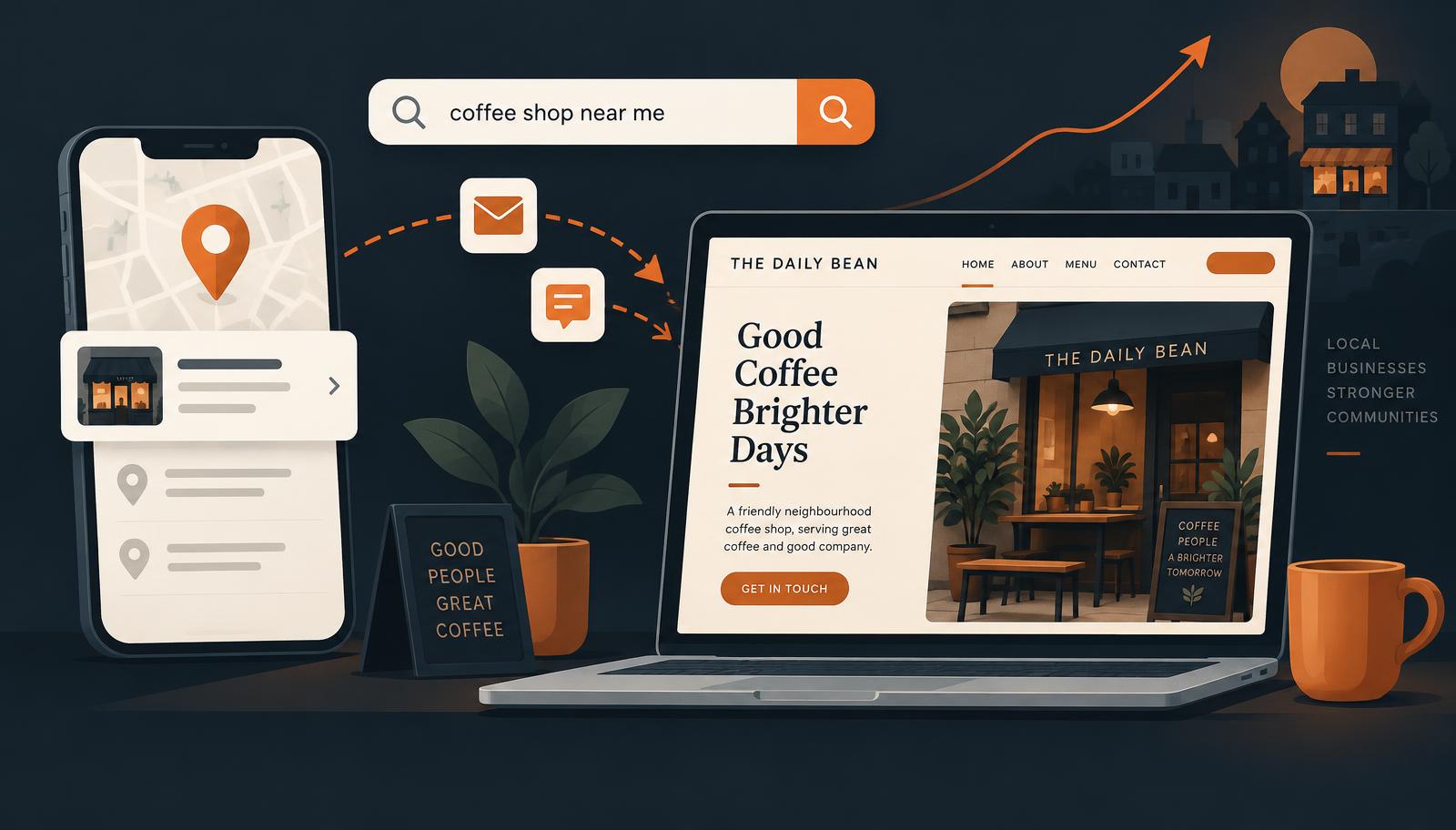
For many local and service businesses, this includes Google Search and Google Maps.
Your Google Business Profile can be especially important.
We look at areas such as:
- business information
- categories
- services
- locations
- opening hours
- images
- reviews
- consistency with the website
- links
- service areas
For a business serving a particular town or region, Google Business Profile and local search can sometimes be every bit as important as the main website.
Organic growth through SEO
SEO should not simply be about trying to rank for as many keywords as possible.
The objective is to become visible for searches that have commercial value.
If you are a physiotherapist, surveyor, accountant, tradesperson or professional service business, you don't necessarily need thousands of visitors.
You need the right visitors.
That can mean improving:
- service pages
- location pages
- page titles
- headings
- internal links
- site structure
- local relevance
- content
- technical SEO
- Google Search Console
- indexing
SEO is generally a longer-term investment.
Done properly, it can build an increasingly valuable source of enquiries over time.
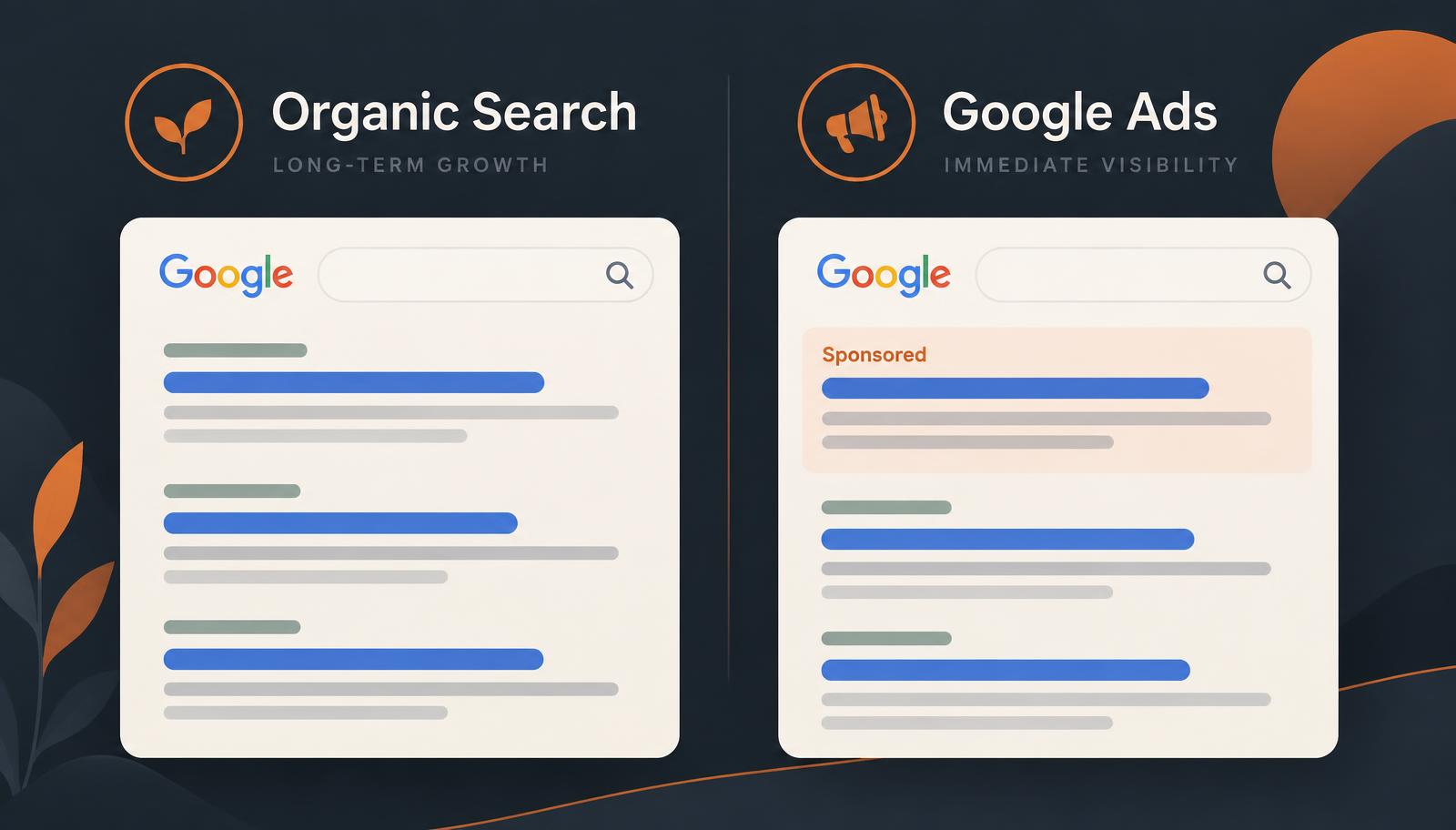
PPC can generate visibility more quickly
Organic search isn't the only route.
Google Ads can put a business in front of potential customers almost immediately.
But paying for clicks only works commercially if the rest of the journey performs.
Sending paid traffic to a weak page simply means paying to expose the weaknesses faster.
Before increasing advertising spend, we want to know:
- Are the right searches being targeted?
- Are irrelevant searches being excluded?
- Is the geographical targeting correct?
- Does the landing page match the advert?
- Is there a clear next step?
- Are enquiries being tracked?
- Do we know which campaigns actually produce customers?
PPC should be accountable.
The objective isn't more clicks.
It's more useful business.
Getting traffic is only half the job
This is where many businesses stop.
They measure:
- website visitors
- Google rankings
- impressions
- clicks
Those numbers can be useful.
But none of them pay the bills.
The more important question is:
What happens after somebody arrives?
A visitor needs to quickly understand:
- who you are
- what you do
- whether you serve them
- why they should trust you
- what they should do next
That means looking at the website from the customer's point of view.
Is the phone number obvious?
Is the contact form unnecessarily long?
Can somebody book online?
Can they message through WhatsApp?
Are reviews visible?
Are prices explained where appropriate?
Do you answer their obvious questions?
Good conversion isn't about tricks.
It's about removing reasons for somebody to leave.
Then we look at what happens to the lead
Generating an enquiry is not the end of the process.
It's the beginning.
Imagine somebody visits your website at 7:30pm.
They are ready to buy.
They call.
Nobody answers.
They try the next business in Google.
That lead may have cost you money to generate, but the opportunity disappeared because the next part of the system wasn't ready.
This is where automation and AI are becoming increasingly useful for smaller businesses.
AI receptionists and smarter enquiry handling
AI is becoming practical rather than theoretical.
One example is an AI receptionist.
For the right business, an AI receptionist can help:
- answer incoming calls
- deal with common questions
- capture customer information
- identify what service the caller needs
- take messages
- route enquiries
- arrange appointments
- provide basic information outside normal working hours
It doesn't necessarily replace a person.
It can help make sure genuine enquiries aren't simply lost because nobody could answer the phone at that moment.
There are many other opportunities for sensible AI and automation.
For example:
- automatically acknowledging enquiries
- qualifying leads
- appointment reminders
- quote follow-ups
- missed-call responses
- CRM updates
- review requests
- recurring customer reminders
- email sequences
- lead notifications
The aim isn't to automate everything.
It's to automate the repetitive parts that slow businesses down or allow opportunities to fall through the cracks.
More leads are useless if nobody follows them up
One of the most overlooked areas of business growth is follow-up.
A potential customer may:
- make an enquiry
- ask for a quote
- receive the quote
- become busy
- forget about it
That doesn't necessarily mean they aren't interested.
Yet many businesses never contact them again.
A simple automated follow-up can make a significant difference to the customer journey.
For example:
Day 0: enquiry acknowledged immediately.
Day 1: personal response or quote.
Day 3: polite follow-up.
Day 7: another helpful reminder.
Later: appropriate ongoing contact where relevant.
That isn't aggressive selling.
It is simply making sure genuine opportunities aren't forgotten.
Sometimes the answer is more customers. Sometimes it isn't.
Growth doesn't always mean getting as many enquiries as possible.
A business might already be busy but attracting the wrong type of work.
The better question might be:
How do we attract more of the customers we actually want?
That can involve looking at:
- pricing
- service positioning
- profitable services
- geographical areas
- ideal customer type
- lead quality
- marketing channels
- website messaging
Ten high-quality enquiries can be worth far more than fifty poor ones.
That is why we focus on growth, rather than simply traffic.
The website is the hub
We still believe the website is incredibly important.
For most businesses, it is the place where everything comes together.
Google Search sends people there.
Google Ads sends people there.
Your Google Business Profile links there.
Social media links there.
Potential customers research you there.
Reviews support what they see there.
Your website often becomes the point at which somebody decides whether your business feels credible enough to contact.
So yes, sometimes we'll recommend building a better website.
But the website isn't the final objective.
Growth is.
How We Forge Growth approaches business growth
Our approach is straightforward.
1. Understand the business
We look at what you sell, where your customers come from, which services matter most and what you're trying to achieve.
2. Review what's already there
Website, Google presence, SEO, advertising, customer journey, enquiry handling and follow-up.
3. Find the bottleneck
Is the problem:
- visibility?
- traffic?
- trust?
- website conversion?
- lead quality?
- slow response?
- poor follow-up?
- lack of automation?
4. Fix what matters
That might mean SEO.
It might mean PPC.
It might mean improving Google Business Profile.
It might mean automation.
It might mean AI.
And yes — sometimes it might mean building a new website.
5. Measure what happens
The final question is always the same:
Is it helping the business?
Because marketing activity is only worthwhile if it contributes to real commercial results.
Growth isn't one product
That is probably the simplest way to explain We Forge Growth.
We aren't here purely to sell websites.
We aren't here purely to sell SEO.
We aren't here purely to run Google Ads.
And we aren't here to add AI to a business simply because AI happens to be fashionable.
We look at the business, the customer journey and the opportunities.
Then we work out which parts need improving.
Sometimes that's one thing.
Sometimes it's several connected things.
Because sustainable business growth rarely comes from a single button, advert, website or piece of software.
It comes from making the whole journey work better.
Want to know where your biggest opportunity is?
If you're trying to grow your business but aren't sure whether the problem is your website, Google visibility, advertising, conversion or lead handling, start by finding out what's actually happening.
Our free Website Check can give you an initial view of how your website performs across trust, messaging, conversion, SEO, navigation and mobile experience.
Or speak to us about the wider customer journey and we'll help you identify where the biggest opportunities may be.
Your website is the hub. Growth is the goal.